

Compact Blocks FAQ
- Source
- Bitcoin Corebitcoincore.org
- Originally published
- Original length
- 10 min read
- Language
- English
SATWEI summary
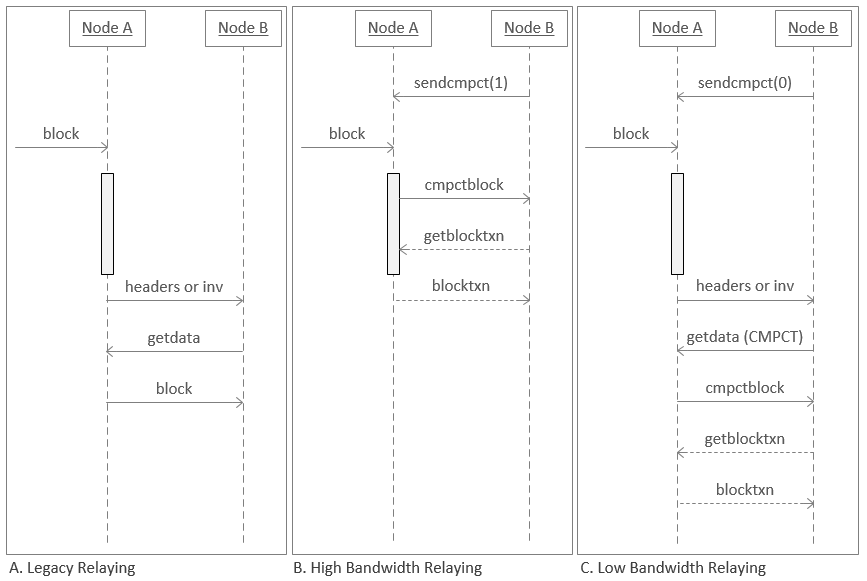
Peers using compact block relay (BIP152) exchange a sketch of each new block, about 9KB for an average 1MB block, plus overhead for transactions the receiver lacks. In live high-bandwidth experiments with up to 6 prefilled transactions, well over 90% of blocks propagated with no follow-up request.
From the original
Tags
- Compact blocks
- P2P
- Relay policy
More from Bitcoin Core
Slow unbounded memory growth on paused pre-BIP31 peers
By pretending not to support BIP 31 pings, a malicious peer could dodge the 20-minute disconnect and read slowly, swelling a node's send queue by up to 2MB per hour for each inbound peer and 5MB for each outbound one. CVE-2026-117349, rated Medium, is fixed by #36667 in Bitcoin Core 32.1, 31.2, 30.4 and 29.5; -blocksonly nodes were much less exposed.
Bitcoin Core

Bitcoin Core 30.4 released
Bitcoin Core 30.4 stops treating BIP 9 bits 5 to 28 as soft fork signals, following BIP 323, so blocks that set them no longer trigger unknown-deployment warnings (#34779). Network changes include a timeout enforced on paused send peers (#36667), and flatfile positions now use 64-bit integers (#36669).
Bitcoin Core

Unbounded memory growth through TCP urgent data on non-Linux systems
Windows, macOS and BSD nodes could be crashed by a connected peer sending TCP urgent data, which slipped past paused reads in the select() backend and queued memory without limit (CVE-2026-117350). Linux nodes use poll() and are not affected. Bitcoin Core 32.1, 31.2, 30.4 and 29.5 fix the Medium-severity bug, which an LLM scan under Project Loupe found.
Bitcoin Core